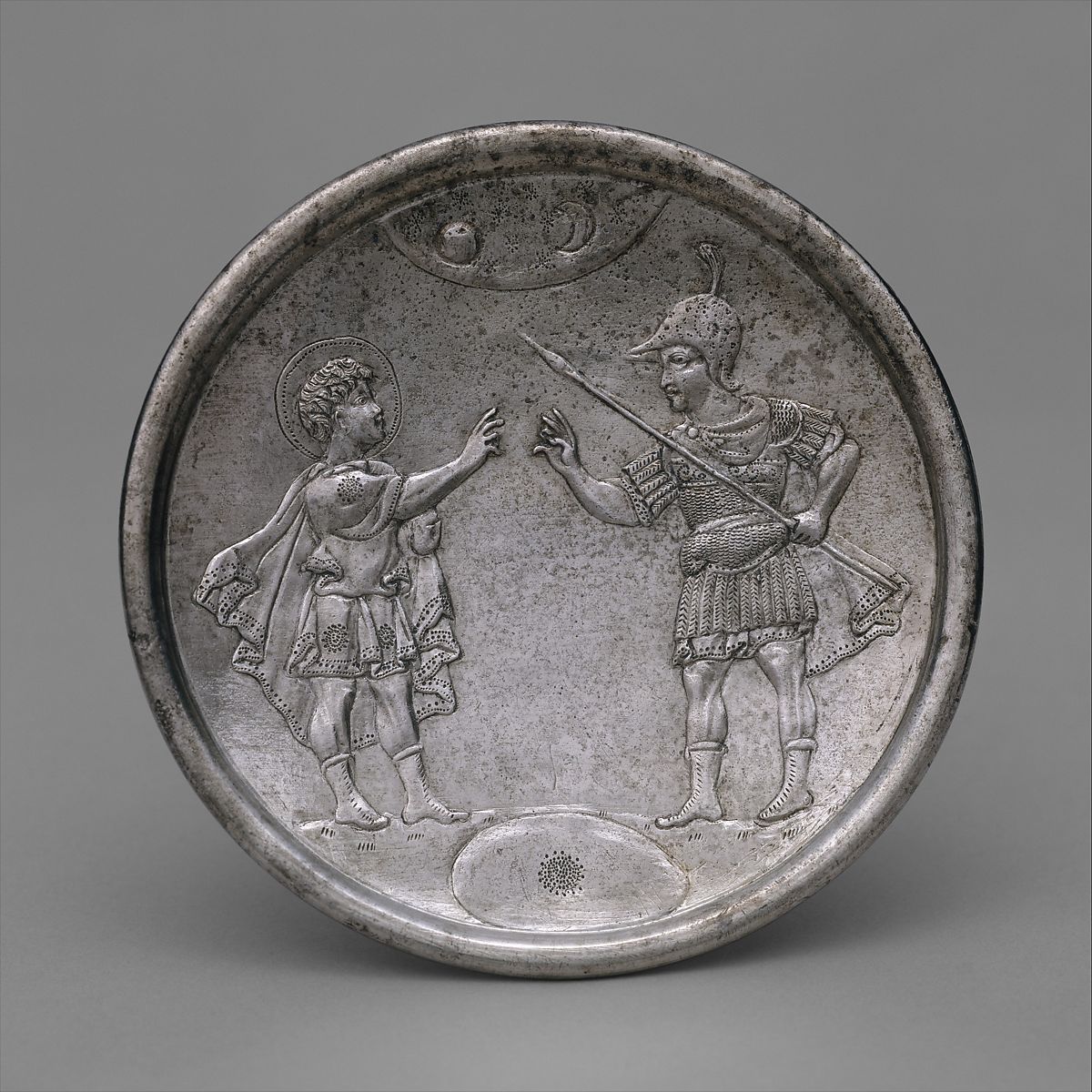
The Met Fifth Avenue, New York
In an earlier post I suggested that there are some hints in the Bible that David’s childhood may have been troubled. In the story where the prophet Samuel went to the hometown of Jesse to find and anoint the future king of Israel (1 Samuel 16), Samuel invited Jesse and his sons to a communal event. It is here that we first meet David’s oldest brother, Eliab, a man of imposing stature. On meeting him apparently for the first time, based solely on appearances, Samuel presumed he was the one chosen by God to be the next king of Israel and immediately exclaimed “Surely the LORD’S anointed is now before the LORD” (1 Samuel 16:6). After seven of Jesse’s sons were introduced to the prophet, Samuel asked “Are all your sons here?” to be told, “There remains yet the youngest, but he is keeping the sheep.” (16:11). We never learn why David wasn’t invited along with his brothers to the event. Surely a worker could be found to look after the sheep! (In fact, in 1 Samuel 17:20 we learn that on another occasion David left the sheep with a keeper.) It makes me wonder if there was a reason why David wasn’t considered to be quite equal with his brothers.1
There is a further clue in one of the two biblical accounts of the David and Goliath story (for my take on the two versions of the story and how they were eventually merged together see my post about David and Goliath). The Hebrew version of the story (but not the Greek version) tells us that David was sent to the battlefield by his father simply to deliver some provisions to his three oldest brothers (Eliab, Abinadab, and Shammah). However, they didn’t particularly welcome their kid-brother being there. We know that because of the reaction of the eldest brother, Eliab, who we meet again:
His eldest brother Eliab heard him talking to the men; and Eliab’s anger was kindled against David. He said, “Why have you come down? With whom have you left those few sheep in the wilderness? I know your presumption and the evil of your heart; for you have come down just to see the battle.”
1 Samuel 17:28
No explanation is provided for why Eliab was angry with David but his remark about David’s job being to look after “a few sheep” is belittling. Robert Alter translates this as “that bit of flock” which really highlights his contempt for David.2 Then he strikes a blow by attributing a specious motive for David’s unexpected arrival: “I know your presumption and the evil of your heart.” The Hebrew here is emphatic: אֲנִ֧י יָדַ֣עְתִּי literally, “I myself, I know …” This suggests there is some history behind Eliab’s remarks. He knows what David is like because of past experiences; this is not a one-off incident but, as he sees it, it is part of a pattern because of David’s “evil heart.” We aren’t given any information as to why Eliab felt this was a pattern of behaviour, but he obviously wasn’t pleased to see his younger brother.
Then, in Psalm 51:5 [v.7 in the Hebrew], written (according to its title) by David after his adultery with Bathsheba had been exposed, he says “In sin I was born and in sin my mother conceived me.” Is there a hint here that David was conceived out of wedlock? Was he sent to keep the sheep when his brothers were invited to an important occasion because as an illegitimate son he wasn’t regarded as fully one of them? It’s noteworthy that David’s mother is never named in the records, although several women and wives are listed in the chronologies of David’s family. This could explain both why David wasn’t initially considered to be a “full son” of Jesse, and could also provide a clue to David’s pattern of behaviour. If David was rejected as a child by his own family this could explain why he later needed to prove himself and why he needed to convince himself that he was worthwhile, or even better than everyone else. I’ve argued in several posts that David probably suffered from what we now call Narcissistic Personality Disorder (NPD). Narcissists are not necessarily thoroughly bad people (having an “evil heart” as Eliab put it), although they are generally deeply troubled. Many experts argue that their personality disorder most likely develops in response to childhood circumstances which produce in them a fear of abandonment and a lack of self-esteem. Their narcissism is a cover for feelings of inadequacy.
Incidentally, we meet Eliab again when he became David’s “chief officer” over Judah3 and also discover that his daughter Abihail married Jerimoth, son of David (her first cousin) and their daughter Mahalath married Rehoboam, Solomon’s son and therefore David’s grandson, her second cousin through her mother, and first cousin once removed through her father (2 Chronicles 11:18). Apparently the relationship between David and his brother Eliab was later friendly, if not close, although Eliab may simply have realised on which side his bread was buttered and learned that it was better to work with David and not against him.
On a final note, I will leave it to Stephanie to comment on the artwork above in a later post.
_________________________
1 Strangely, in 1 Chronicles 2:15 David is called the seventh son of Jesse when he was, in fact, the eighth, although the chronologies in 1 Chronicles pose several other problems as well.
2 Alter, Robert, The Hebrew Bible: A Translation with Commentary. New York: W. W. Norton & Company, 2019, vol 2, 247.
3 Chronicles 27:16-18 Elihu and Eliab [ and also Eliel] are variations of the same name cf. 1 Samuel 1:1; 1 Chronicles 6:7, 12, 19 [HB, Eng. v.22, 27, 34)].
 מִקְרָא Mikra: Biblical studies
A very interesting hypothesis! A Yisraeli friend who came to me in 17 was well-schooled in the beth Yehudah oral traditions that do not make it into the books and google. He first mentioned this to me ie. Dovid was an illegitimate red runt as his mother had been unfaithful thus, according to haTorah he was a mamzer!
If you are not already familiar with the benai Yisrael maShomronim (Israelite Samaritan) tradition of the division of the priesthood with Eli setting up Shiloh as a rival worship centre of YHVH please look into it as it is the truth.
Its my belief that Eli Stole haEben/ haTsar (the pillow eben of Yacov, and eben Mosheh hit etc) from Har Gerizim as placed there by Yehoshua ben Nun ben Ephraim and set up Shiloh as a rival worship centre with haEban and a fake qodesh mishkan. Sepher Shmuel accurately records Elis’s sons were evil and” like father like son” Eli also was evil in the sight of YHVH. Eli was ben haLevi being an illegitimate Kohen gadol . It seems that he fathered Shmuel haNavi (his sons are recorded as having sexual relations with the women who came to worship at Shiloh) Hannah who had an infertile ben Ephraim husband could not conceive from him so thus went to Eli the fake haKohen hagadol who gave her some of his zera, the boy Shmuel was returned to his Abba to grow up and he learned Elis Evil ways. Shmuel haNavi got it wrong big time with his appointments of Melechim. If he was true Navi he surely would not have made such poor appointments!
The firstborn belongs to YHVH according to haTorah thus Yishai firstborn and if not him his 6 other sons should have been in line before Dovid to be haMelech it begs the question then of who was haAbba of Dovid?? The most likely contender would be Shmuel haNavi who seems to have continued the role of the legitimate hoKohen haGadol in that he used the Urim and the Trium. Chronicles records Shmuel as benai Levi rather than benin Ephraim as sepher Shmule attests. Dovids sons continue the line of rebellion and walking against the ways of YHVH, Yedidiah haMelech included!
Psalm 51:5 : “Behold, I was shapen in iniquity; and in sin did my mother conceive me.” Is this oke for real ? Is he really trying to attribute blame to his mum for his rape of Bathsheba, his murder of Bathsheba’s husband Uriah (and the worse one for me: waiting for his illegitimate infant to die, then literally celebrating the infant’s death). The world actually celebrates this vile excuse of a man. Shame on us.
An interesting similar suspicion about identity that captured my attention was the mysterious appellation “sons of Zeruiah”. The first mention of them is in 1Samuel 26:6 and the first son active on the scene is Abishai, literally son of Jesse. Somehow I always suspected those sons were not David’s nephews but brothers especially because the initial formation of his band of followers in Samuel 22:1-2 mentions his brothers and the rest of his father’s household as the constituents. Given your suspicion I would propose David himself was a son of Zeruiah, just a speculative thought I admit, but it would make sense as he depends on their support and at the same time he often fears them.
Excellent article. Have you considered the parallels between David and Jephthah as an addition hint David was illegitimate?
Thanks for the comment. I haven’t considered parallels with Jephthah, but it would be an interesting angle to investigate.
A colleague of mine did his dissertation on the Jephthah stories, and his thesis was that each of the three major judges are parallel to each of the first three kings of Israel. The Samson and Solomon parallels are the more obvious, but the fact that Jephthah is driven away from his family for a period of time before being invited back to defend against the ammonites is an intriguing parallel.
That’s interesting, and the idea sounds familiar. I may have read something about it. Who is your colleague and has his dissertation been published?
Interesting thoughts Stephen, would David have had the same mother as his brothers or is it possible that Jesse had a second wife/concubine? I suspect that the latter would have been more likely if David was a half-brother to his older siblings – the family tree is generally traced through Jesse
My thinking John is that the other seven brothers were “legitimate” with a different (lawful) mother and that David’s mother was not a lawful wife/concubine – hence “in sin I was conceived”.