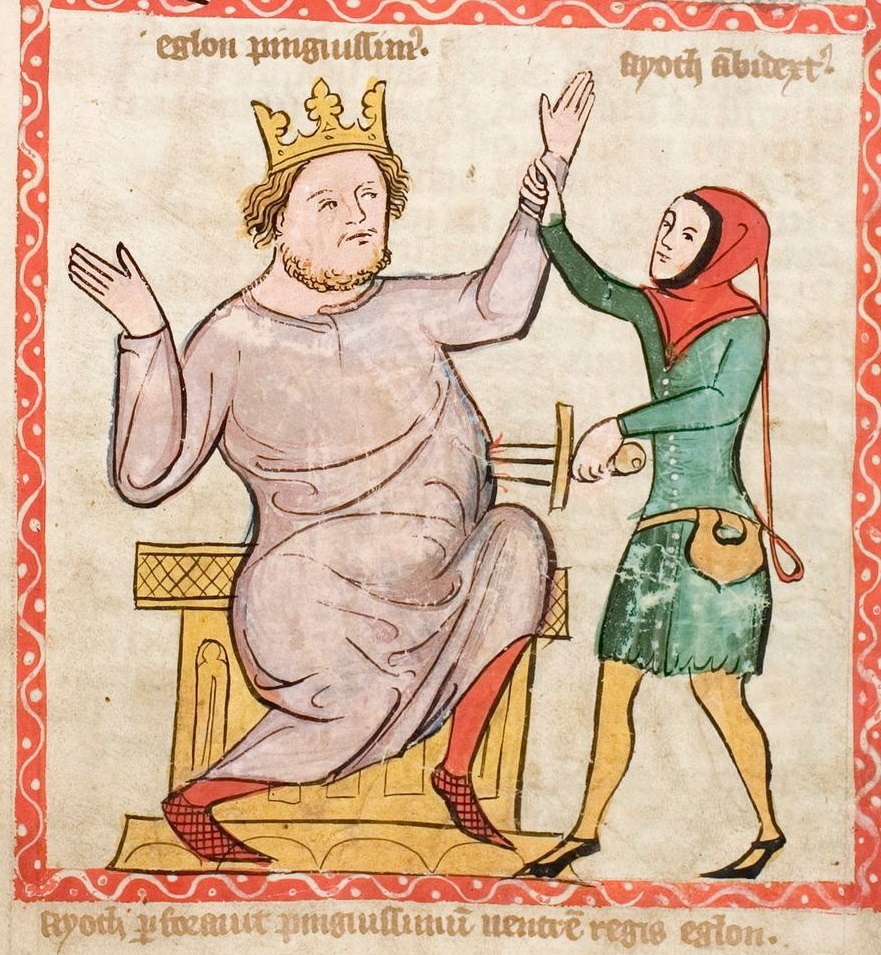
The Bible has at least four cases of “toilet humour” including a murder-mystery that takes place in a toilet, although some people might question whether a murder in the toilet could possibly be classified as humour. Perhaps the mere mention of a toilet in an unexpected setting (like the Bible!) is titilatting at least, if not actually funny, but whether or not we classify this story as humorous partly depends on what we classify as humour. Some Bible-readers might also not be aware of this particular murder-mystery because the word “toilet” doesn’t occur in any English translation that I’m aware of. Let’s take a look. This story occurs in Judges 3:12-25 and describes how Ehud saves Israel from oppression by assassinating Eglon, the king of Moab.
As the story goes, Eglon defeated Israel in battle and thereafter “the Israelites served King Eglon of Moab eighteen years” (14) and paid him tribute. “But when the Israelites cried out to the LORD, the LORD raised up for them a deliverer, Ehud son of Gera, the Benjaminite, a left-handed man” (15). The fact that Ehud was left-handed is an important detail, as we shall see. Ehud presented himself to king Eglon to pay the tribute, and after leaving he then sent the people who carried the tribute on their way and turned back to present himself before the king again, saying ““I have a secret message for you, O king” (19). Eglon sent all his attendants from the room, whereupon Ehud approached him saying “I have a message from God for you” (20). The phrase “a secret message” has a double meaning in Hebrew because the phrase דְּבַר־סֵתֶר can mean either “a secret word” or “a secret thing.” The secret “thing” turned out to be a hidden sword! With his left hand he reached for a sword which he had concealed by strapping it to his right thigh, and the Bible provides the graphic details that being left-handed he “thrust it into Eglon’s belly; the hilt also went in after the blade, and the fat closed over the blade, for he did not draw the sword out of his belly” (21-22). Then follows another detail which is difficult to translate, chiefly because the phrase includes a word which doesn’t occur anywhere else in the Bible (the technical term for such a word is hapax legomenon), but means either “and he defecated” or “the blade went to his anus” (if you’re interested in the technical details see the footnote [1], otherwise read on). Either way, it apparently caused a stench because Eglon’s attendants outside the room assumed he was “relieving himself” (24).
Then we get a real Agatha Christie style murder mystery. Ehud left the הַֽמִּסְדְּרוֹנָה misdarôn, (whatever that is) “and closed the doors of the הָעַלִיָּה alı̂yyâ (whatever that is) on him, and locked them” (23) and left without arousing suspicion. When the Hebrew says he “closed the doors on him” it means he closed them from the inside, locking himself in. So when Eglon’s attendants became concerned about how long he’d been in the locked room, they had to use a key to unlock the door (25). A locked room, a dead man inside, and no one else. Whodunnit? And how did Ehud escape unnoticed?
To unravel the mystery it helps to know the meaning of the architectural terms which are sprinkled throughout the story, and what archaeology has revealed about the layout of ancient palaces. Our first clue is in the phrase which says Eglon was sitting בַּעֲלִיַּת הַמְּקֵרָה in the raised mᵉqērâ (whatever that is). The NRSV translates this “his cool roof chamber”. A problem with this translation is that in that part of the country the roof would have been hot, and the coolest room would be close to the ground or below it. “Cool” doesn’t work. The word they’ve translated as “roof” (aliyya) can mean upper, or elevated, not necessarily on the roof, and I would translate it as “raised.” The word מְקֵרָה mᵉqērâ is more difficult. It may come from a root קָרַר meaning to be cool (hence the NRSV translation) but equally could refer to a “well-ventilated room” (as the NET Bible has it, with the note that this probably refers to a room with latticed windows which allowed the breeze to pass through). As Eglon’s attendants later assumed that Eglon was relieving himself (perhaps due to the smell and the fact he was in his locked room for so long), it’s highly likely that this “well-ventilated room” was in fact his toilet. The word מְקֵרָה mᵉqērâ could, however, derive from the root קָרָה and refer to roof beams. [2] Baruch Halpern argues that the phrase בַּעֲלִיַּת הַמְּקֵרָה means “above the beams” and refers to a raised platform with a space beneath, probably the elevated podium where the king’s throne was situated [3]. How would this fit with the assumption made by his attendants that Eglon was on the toilet?
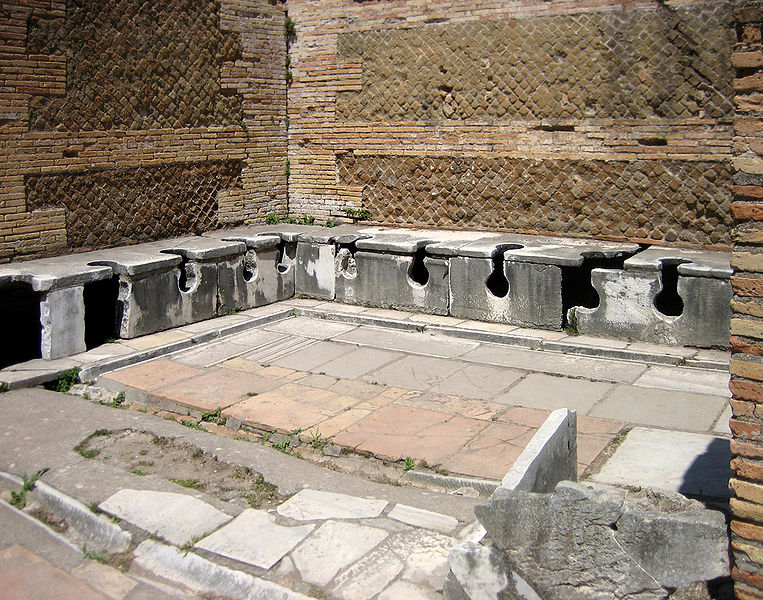
Looking at archaeological remains of toilets in the ancient world, we discover that in many places they were much less private than we are accustomed to in the modern western world. At several sites archaeologists have uncovered communal toilets where several people would sit together and engage in conversation or even conduct business while on the toilet (which adds new meaning to “doing your business”!), as in the illustration from Ostia Antica. Elsewhere, toilets have been found close to the throne in royal palaces (which also gives new meaning to “the throne room”). In Eglon’s palace the toilet may have been on the raised platform “above the beams” where he was sitting when Ehud approached him, or close to it. Placing the toilet on a raised platform would be a logical place for it (attested by archaeological findings), so that the excrement could be accessed and removed from below. This may provide the explanation for how Ehud escaped from a locked room, and the meaning of the term misdarôn. Piecing together the biblical and archaeological evidence, Halpern suggests that misdarôn means something of the order of “the hidden place,” an appropriate designation for the area under the beams. He thinks that Ehud, having fastened the doors of the raised platform from inside, swung down through an opening in the floor to the level below. He emerged, through the door which provided access for the servants to remove the waste, into the audience chamber and crossed deliberately to the main door and strode out unchallenged and without suspicion, leaving Eglon dead on the floor of his locked room.
So the mystery of how the culprit made his escape after the murder in the toilet may be solved, but is it humorous? There are a couple clues that the writer may have used the death in the toilet as a way to mock or ridicule his subject. First, there is a pun on Eglon’s name which means “circular” or “round” and his description of him as a fat man. The writer has probably invented this name (surely his parents didn’t actually name him “Tubby”!), or changed it slightly so that his actual name was ridiculed. Then we are told that Ehud was left-handed. This is important for the story because it explains how he was able to smuggle in his weapon undetected and reach for it with his left hand, but the humorous part is the detail that he was of the tribe of Benjamin, and ironically “Benjamin” means “my right hand son”! (See my post about left-handed men in the Bible for more details).
Finally, the narrator goes on to mock the defeated Moabite warriors as also being fat (in v. 29 the NRSV translates שָׁמֵן וְכָל־אִישׁ חָיִל as “strong, capable warriors” but the word שָׁמֵן really means “fat” rather than “strong”). The writer uses a body-shaming insult: with their fat king gone the fat Moabite soldiers were easy prey for Ehud’s warriors.
If this story is humorous, then it’s the mocking, ridiculing, insulting kind of humour that occurs in quite a few places in the Hebrew Bible. The writer and the initial audience were having a laugh at their enemy’s expense, with a cluster of toilet-related remarks about bad smells and faeces which were intended to demean their subject. It’s certainly not “polite” humour, and therefore may be unexpected in the Bible, but it’s there just the same. However, the point of the story was not simply to ridicule or to amuse. It seems there are other underlying sub-themes which suggest it may have had a polemical purpose. First is Ehud’s connection to the tribe of Benjamin, the tribe of king Saul. There are a few ‘strange’ stories in the Bible involving people from this tribe and I will look at more of them in the future. They seem to have a propaganda purpose targetting the tribe of Saul as opposed to the tribe of David (Judah). Second is the similarity between this story where Eglon was killed in his toilet, and a story in which David was hiding in a cave when Saul came in to relieve himself. David could have taken his opportunity and killed Saul, but he didn’t. The writer, or a pro-David editor, could have been saying “see, Benjaminites are not averse to murdering people in their toilet, but Judahites are too decent to do that!” Interestingly, the Talmud seems to have picked up on this being part of a Saul vs David polemic, and claims that David was a descendant of king Eglon through his grandmother Ruth who was from Moab. What began as a crude anti-Moab story may have been re-purposed to become an anti-Benjamin or anti-Saul polemic.
[1] The phrase in Hebrew is וַיֵּצֵא הַֽפַּרְשְׁדֹנָה which means something (whatever the פרשדן is) went out. The final ה isn’t a feminine ending, it’s a locative or directional ה which indicates a movement towards something. David Clines (Dictionary of Classical Hebrew) lists several possible meanings for פרשדן – excrement, anus, vent, place of excrement. The verb וַיֵּצֵא went occurs a few times in this story. In fact, it occurs immediate after in the phrase וַיֵּצֵא אֵהוּד הַֽמִּסְדְּרוֹנָה and Ehud went to the misdarôn (whatever misdarôn” is – this is another hapax legomenon, presumably an architectural term of some kind), and again in the next verse. Some scholars have suggested that פרשדן is another architectural term (Koehler and Baumgartner, Hebrew and Aramaic Lexicon of the Old Testament suggest “entrance hall”). In fact, there are a cluster of architectural terms in this story so it is a possibility that this phrase should be translated ” … and he (Ehud) went out to the [somewhere].” This would be odd because the next phrase is “he went out to the misdarôn.” Either the writer is describing Ehud’s procession through two or more rooms/spaces, or the first וַיֵּצֵא describes the blade (in Hebrew there is no difference between “he” and “it”) going through to Eglon’s anus, or the contents of his bowels exiting his body, while the second וַיֵּצֵא refers to Ehud leaving the room. The NRSV translates this as “the dirt came out” (referring to his faeces), Baruch Halpern translates it as “and out ‘it’ came at the anus” (which could refer either to the blade, or his faeces) while Ferdinand Deist translates it as “the blade went in the direction of his anus.” Deist, Ferdinand. “‘Murder in the Toilet’ (Judges 3: 12-30): Translation and Transformation.” Scriptura: Journal for Biblical, Theological and Contextual Hermeneutics 58 (1996): 263-272, here 265.
[2] The word is used with this meaning (“beams”) in Psalm 104:3; Nehemiah 2:8; 3:3, 6; 2 Chronicles 34:11.
[3] See Halpern, Baruch. “The Assassination of Eglon: the first locked-room murder mystery.” Bible Review 4, no. 6 (1988): 38-41, 44; Halpern, Baruch, The First Historians: The Hebrew Bible and History. University Park, Pa.: Pennsylvania State University Press, 1996, 39-75.
 מִקְרָא Mikra: Biblical studies