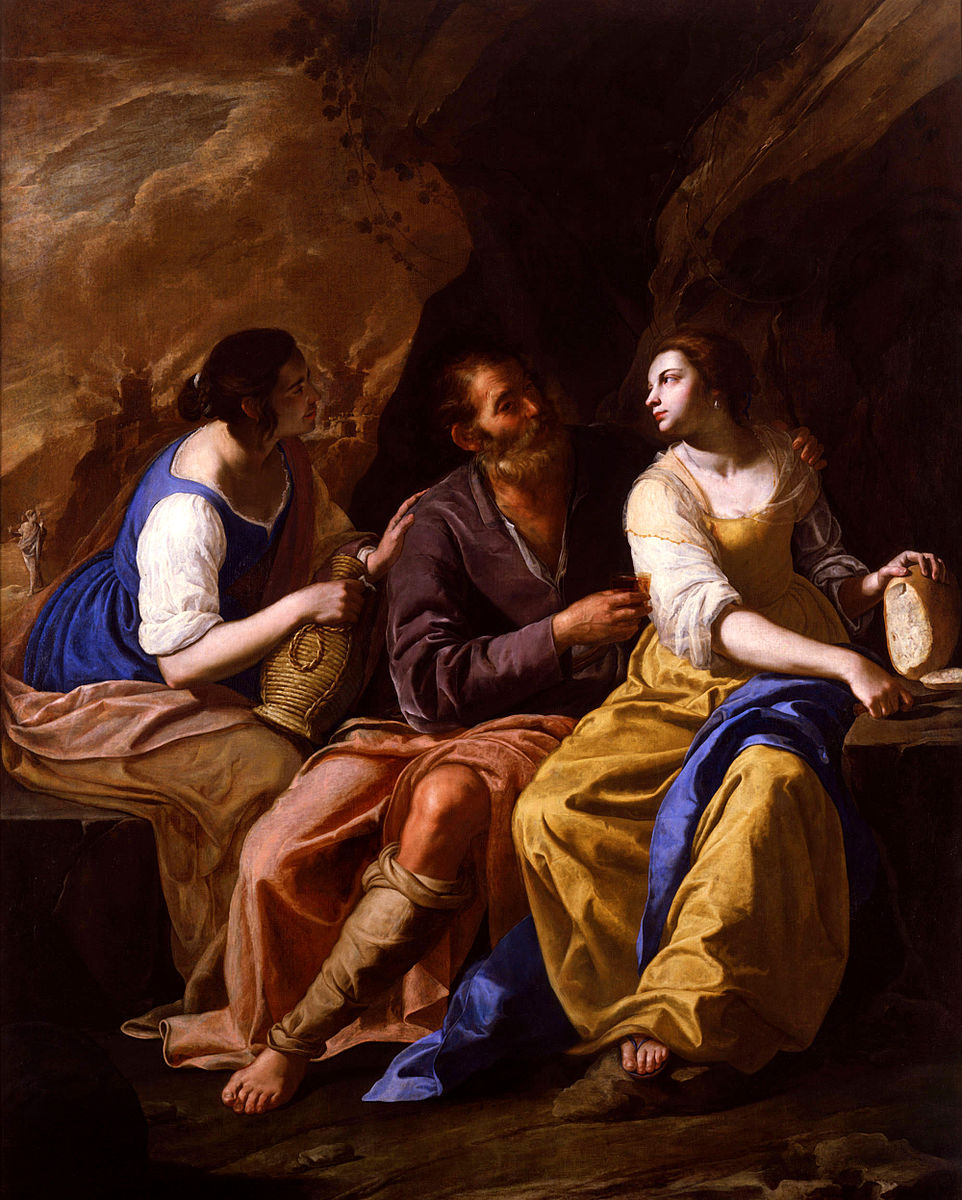
This second part of the story of Lot and his daughters in Genesis 19 is as bizarre as the first part, if not moreso. This past semester at The University of Sydney I taught (for the third time) an Advanced Hebrew unit which we call “Sex, Drugs and Rock ‘n’ Roll in Biblical Law and Narrative” (full credit for that catchy title goes to my colleague Dr Tim Rafferty.) Amongst the texts we looked at was the story of Lot in Genesis 19. Some people read Genesis as serious ancient history, but every time I look at these stories I am impressed by the abundance of wordplays which tells me that the writer was being very playful, and probably not that serious. For example, in the creation stories we enounter the root ידע to know for the first time in 2:9 when God created the tree of the knowledge of good and evil. What follows is the discussion between Eve and the serpent about God knowing that if they eat from the tree they will become God-like (3:5). Eventually, as we know (excuse the pun), they do eat from it and they immediately know that they are naked (3:7). Then, as the story ends, Adam knows his wife Eve and she conceives and has a son (4:1). We are introduced here to a well-known (there it is again) euphemism for having sex. The writer uses the same root word to take the reader on a journey (a descent perhaps) from the Divine attribute of knowing good and evil, to Adam and Eve reaching out for this knowledge and for Divine status, to the disappointment of merely obtaining an awareness of their nakedness, and finally using the same root word euphemistically for sex. Of course, the writer didn’t need a euphemism and could have used another perfectly good Hebrew word for procreating, or even another one of the various biblical euphemisms for having sex, but instead chose to use the same word. This seems to me to be a deliberate choice of words, a playful re-use of one word with different meanings.
We have another example of a similar wordplay in the same story. In 3:1 we read that “the serpent was more crafty” (עָרוּם) than any other beast of the field. In the verse immediately before this an identical word with a different meaning (a homonym) refers to the man and woman as being naked (2:25).[1] Not only is this a clever wordplay, the narrative may also contain a double-entendre based on it. When Eve is confronted by God about eating the fruit she said: “The serpent tricked or deceived me” (3:13). The word here comes from the root נשׁא “to be deluded” but it can also have the sense of “to be seduced, enticed”. If so, then we have an intriguing combination of seduction and nakedness. The writer may have been deliberately creating a sexual image of a “naked” serpent “seducing” Eve. Again, the writer could have used another word for “beguile” or “trick” to avoid confusion instead of one which was identical to the word for “naked” which would be used in the next verse, but chose to use one word with two different meanings in close proximity.
This brings us back to our story about Lot. We pick up the story again after Lot and his daughters escaped the destruction in Sodom with Lot negotiating with his two rescuers to let them stay in a small town or city called Zoar (19:19-22). But then, without any further explanation (there are a lot of unexplained things in this story), Lot changes his mind and leaves Zoar:
Lot went up from Zoar and settled in the hill country with his two daughters, for he was afraid to dwell in Zoar; and he and his two daughters lived in a cave. (Genesis 19:30).
Now it becomes even more interesting with respect to wordplays. The word for “cave” (in Hebrew it has the definite article so means “the cave” although we have no idea why it was “the” cave and not “a” cave) is מְעָרָה which comes from the same root as “naked” in the Garden of Eden story (ערה) – I guess a cave is literally a “naked” or “bare” place. So in the first part of the story, set in Sodom, the writer was playing with the root word “to know” so that it’s meaning was somewhat ambiguous (did the men of Sodom simply want to get to know the strangers, or did they want to have sex with them?), and now there is a wordplay on being “naked”. Putting aside the theories of multiple authors of Genesis for a moment (the Documentary Hypothesis) it looks like these two stories (Adam and Eve, and Lot and his daughters) had the same author, or at least liked to use the same wordplays around “knowing” and “being naked”.[2]
Interestingly, while the Adam and Eve story uses the phrases “the man knew his wife” as an euphemism for having sex, the story of Lot and his daughters uses different euphemisms. First, when the daughters devise a plan to conceive children by their father they say “there is not a man on earth to come in to us after the manner of all the world” (19:31. This is actually quite strange because they had just come from Zoar, a town or city which we know from elsewhere in Genesis was big enough to have a king and an army. What did they mean by “there is not a man on earth to come in to us”?)This is a very unusual way to talk about conceiving children (and in the Bible it occurs only here). Perhaps it is simply an extremely polite way for young women to avoid speaking directly about having sex. However, immediately after this they say “let us make our father drink wine, and we will lie with him, so that we may preserve offspring through our father” (19:32) using another two euphemistic phrases. As the story unfolds we learn that on two consecutive nights the daughters “went in, and lay with her father; he did not know when she lay down or when she rose” (34-35). Finally, “the daughters of Lot became pregnant by their father” (36). The phrase “to lie with” is a fairly common euphemism in the Hebrew Bible, similar to the English euphemism “to sleep with (someone)” – in fact, it may be where the English expression originates. There is nothing noteworthy here with any of these expressions. What is worth noting is that the only times when the story uses the word “to know” it uses it with the normal meaning and not euphemistically (as in “Lot knew his daughters”). What is even more noteworthy is that Lot was apparently so drunk that he didn’t know what was happening, but not so drunk that he was impotent! This is so unrealistic that some commentators argue that Lot knew exactly what was happening, but feigning drunkenness he took the opportunity to have sex with his daughters while denying responsibility. In the context of the ambiguity earlier in the chapter about whether “knowing” simply meant to become acquainted or having sex, I think it is significant that here the writer could use the euphemism unambiguously but avoids it and uses other euphemisms instead, and uses the knowing word with its regular meaning.
So, back to Adam and Eve, and to the beginning of the Lot story. I argued above that in Genesis 3 the meaning of the word “to know” shifts from Divine knowledge to having sex. Something similar happens in the Lot story, which really begins in Genesis 18 with God visiting Abraham and saying “Shall I hide from Abraham what I am about to do … No, for I know him …” (18:17-19 but why on earth the NRSV translates this as “for I have chosen him” I’ll never understand, because there is a perfectly good Hebrew word for “chosen” and this isn’t it!). Again the story begins with Divine knowledge and then moves on to ambiguous usage where it is difficult to know whether it is a euphemism or not, to then being unmistakeably about sex. Interestingly, the second part of the Lot story uses other euphemisms for having sex but avoids this common one about “knowing” someone, and then ends with Lot “not knowing” what he was doing. With all the wordplays in these Genesis stories I suspect the writer (or writers) is being deliberate rather than careless with the choice of words. Knowing and knowledge is clearly an important theme in these stories – what God knows, what humanity can know, and what role knowledge plays in becoming God-like – and the writer is doing more than simply recording history.
The story of Lot ends with the two sons born to his daughters being named, and how these names connect to the names of the nations Moab and Ammon (37-38). It turns out that these two names are wordplays on something like “son from the father” and “son of my people”, probably referring to the incestuous relationships which produced them. The main purpose of the story may simply be to insult Israel’s neighbours, and enemies – the Moabites and Ammonites – with a story which portrays their origins in a poor light. Strangely, and perhaps surprisingly, the long list of prohibited incestuous relationships in Leviticus 18:6-18 does not actually prohibit sex between a man and his daughter(s)! It probits sex with a grand-daughter, sister, half-sister, and several other relatives (even including sex between a man and his uncle) but misses this one! Was it an oversight, or was it deliberate? Was Leviticus letting Lot off the hook?
Part 3: Lot and his daughters: (3) “the last people on earth”
[1] For those interested in the Hebrew, naked is from the root ערה, to uncover, reveal. Crafty is from the root ערם. The adjectival forms of ערה and ערם are identical (עָרוּם).
[2] There are, of course, other possibilities too. The two stories may have had different authors but the editor or redactor who brought them together added some wordplays of their own; or, the writer of one story was familiar with the other and continued the wordplays.
 מִקְרָא Mikra: Biblical studies
“What is even more noteworthy is that Lot was apparently so drunk that he didn’t know what was happening, but not so drunk that he was impotent! This is so unrealistic that some commentators argue that Lot knew exactly what was happening, but feigning drunkenness he took the opportunity to have sex with his daughters while denying responsibility. In the context of the ambiguity earlier in the chapter about whether “knowing” simply meant to become acquainted or having sex, I think it is significant that here the writer could use the euphemism unambiguously but avoids it and uses other euphemisms instead, and uses the knowing word with its regular meaning.”
That is ingenuous speculation, but I can’t find anything supporting it. Is it just realistic supposing he must have been impotent because he was drunk? I think it’s pushing realism where it doesn’t belong, just to invent intrigue that isn’t even there. Aren’t we forgetting then it is just a story and not about medical science dictating at what point of intoxication impotence sets in. In story logic the point is clear: in desperate conditions the daughters needed a male seed donor to fulfil their wish of bringing forth offspring. Their only way out was tricking their father to fulfil the role so just asking him to do that was supposedly out of the question. Whether the different use of euphemisms is significant here I don’t know because I don’t read any Hebrew. But as a rule similar euphemisms apply in most languages, as we can see in the Greek from the Septuagint. Knowing and laying with are used there too and in the version I read I noticed something else as well, which can solve the question about any presumed impotence at the spot.
καὶ οὐκ ᾔδει ἐν τῷ κοιμηθῆναι αὐτὴν καὶ ἀναστῆναι.
I have seen that in most translations he doesn’t know when/that he lay with her or when/that he woke up. So the οὐκ ᾔδει is extended to both verbs of the rest of the sentence. In my opinion καὶ ἀναστῆναι just means that Lot “rose” to the occasion, to use another euphemism. When you wake up from drunken stupor you are also sobered up and you really would know that you are awake, often with a headache.
“Strangely, and perhaps surprisingly, the long list of prohibited incestuous relationships in Leviticus 18:6-18 does not actually prohibit sex between a man and his daughter(s)! It probits sex with a grand-daughter, sister, half-sister, and several other relatives (even including sex between a man and his uncle) but misses this one! Was it an oversight, or was it deliberate? Was Leviticus letting Lot off the hook?”
Possible, but a bit far-fetched. In the story the daughters tricked their father into a drunken stupor to accomplish their goal so they at least thought it was not appropriate or lawful to just go about it, but when completely isolated from the rest of the human race, (they said there was no man on earth!) do such rules still apply?
The short shelter in Zoar or Segor and the leaving because of some fear is a bit puzzling, I don’t have a clue why they left there, unless it’s just to get the threesome together in a cave.
Hi, Dr. Cook.
I have an additional comment about this text, concerning the verb used for “have sex”. The verb, of course, is שכב, but the following particle shifts back and forth between עם and את.
This use of two different particles came to my attention the other week, when Lev. 18 was part of the parsha. The rabbi and I had a small dispute about the use of את in 18:22. So I began to explore the verb שכב in Sefaria’s dictionary resource.
It seemed from the source that it is well known that this verb, when used to mean “have intercourse” (Safaria’s meaning 3), the verb sometimes take עם and sometimes את. From following the verses given, I conclude that the Bible uses שכב עם when describing marital sex, or when people are talking about sex, but uses את when the sex is transgressive (eg 2Sam 13:14 and Gen 35:22).
This pattern is mostly followed in this story of Lot and his daughters as well. When the elder daughter talks about sex with their father, she uses שכב עם, but when she actually does it, the text switches to
שכב את.
However, the younger daughter’s sex act is described with שעה עם, so ?
Shira Coffee
Hi Shira. This is interesting and I need to look at it more closely.
In the meantime, you may be interested in this comment on שׁכב (Qal) in HALOT (Koehler, Ludwig and Walter Baumgartner, The Hebrew and Aramaic Lexicon of the Old Testament. Leiden: Brill, 2001):
—d) to lie down and have sexual intercourse: with עִם Gn 19:32,35; 30:15; 39:12,14; 2S 13:11; with II אֵת Gn 19:33; 26:10; 34:7; 35:22; 1S 2:22; with sf. אֹתָךְ, אֹתָהּ Gn 34:2; Lv 15:18,24; Nu 5:13,19; 2S 13:14; Ezk 23:8 probably a false tradition for אִתָּךְ, אִתָּהּ, on which see Bauer-Leander Heb. 462o :: KBL on I אֵת, for which there could be support from יִשְׁכָּבֶנָּה (so also SamP. versions) Dt 28:30Q; a man is always the subject, apart from Gn 19:32ff; 2S 13:11.
Well, I don’t know anything about the very early Hebrew language. But trying to follow your reference sounds like a good project for Shavuot! (Despite my execrable German) Thanks for your response!