One of the great ironies of the story of Lot in Genesis 19 is that in the first part of the story he seemingly offered up his daughters to the mob to be gang-raped,[1] while there is an ironic reversal in the second part of the story where, according to some commentators, Lot is apparently raped by his daughters. But was he? Whether Lot was an innocent victim, or compliant in this action, has been the subject of centuries of discussion. For example, a Rabbinic midrash (Bereshit Rabbah 51:9) which was probably written between 300 and 500 CE (although it draws on older traditions and interpretations) discusses Lot’s drunkenness and suggests that Lot actually desired his daughters. It even has a pun on his name לוֹט, adding one letter to form לָחוּט which means “lusts”:
Rabbi Nahman bar Hanan said, “Whoever lusts (לָחוּט) after fornication in the end will be fed with his own flesh.” … it is clear that Lot lusted after his daughters but his daughters did not lust after him.
It may be tempting to see some kind of poetic justice in Lot being raped so soon after he’d offered up his daughters for similar (although arguably much worse) treatment. However, as much as I like finding irony in the Bible, to read the story this way is, in my opinion, to misread both parts of the story. I argued in my first post in this series that Lot didn’t actually offer his daughters to be raped by the mob, and I’d further argue here that to portray Lot as the victim of sexual abuse by his daughters further misreads the intent of the story.
The two unnamed daughters are simply called “the firstborn” and “the younger (one)” and in another wordplay (or soundplay) the term “the younger” (צְּעִירָה ze’irah) looks and sounds very much like צּוֹעַר Zoar, the city they passed through after leaving Sodom. Perhaps there is a reminder embedded in the Hebrew text that they knew full well that they weren’t the last people on earth and that there were still men nearby. So why the urgency and desperation to conceive children by their father? The entire story of Lot in Genesis seems to be a series of poor judgments on Lot’s part, from his initial decision to part with Abraham and move towards Sodom in the first place, to his decision to abandon the town of Zoar despite the angels’ assurances that it would be spared on his account; and then taking his two daughters to live alone in a cave. The daughters are the victims of his proclivity for making poor decisions. Lot also fails to communicate with them what he has been told by the angels: first, that only the Cities of the Plain were marked for destruction; and second, that Zoar would be preserved. There was a whole world out there which was not destroyed! They weren’t the last people on earth!
The midrash on Genesis goes on to argue (59:10) that the reason for this story is that Ruth the Moabitess and great grandmother of King David, and Naamah the Ammonitess and wife of King Solomon (and mother of King Rehoboam), were both descended from Lot and his daughters. Then follows this interesting line in the midrash: “Rabbi Yitzḥak said: ‘I found David My servant’ (Psalms 89:21) – where did I find him? It was in Sodom.” It may be that it was well-known that David, Solomon and Rehoboam had these ancestral connections with Moab and Ammon and the biblical writers/editors wanted to emphasise the connections of these foreign countries to the family of Abraham, and also to the miraculous chain of events which produced them. Even the more embarrassing parts of David’s ancestry could be linked to a miracle. In fact, it seems that the whole point of the book of Ruth is to explain and perhaps smooth-over David’s Moabite ancestry.
By contrast, the horrific story of the gang-rape of a woman in Judges 19 connects to the family of King Saul and may have been written, or preserved, in order to draw the comparison and delegitimise the kingship of Saul while legitimising the dynasty of David.
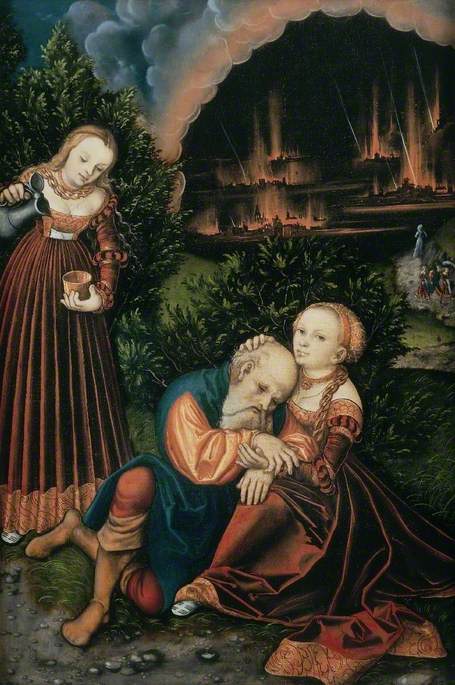
A note on the painting by Lucas Cranach: the story of Lot and his daughters has been a popular theme for artists over the centuries, and Cranach painted this scene at least four times. The burning cities of Sodom and Gomorrah in the background, and the image of Lot’s wife looking towards the cities, could give the appearance that this incident occurred immediately after they left Sodom, and hence suggests a sense of urgency in their desire to have children, perhaps in the mistaken belief that the whole world had been destroyed and they were the only survivors. The story in Genesis 19 doesn’t provide any clues as to how soon after the destruction of Sodom that this incident took place. Cranach depicts Lot’s daughters as duplicitous, with one pouring the wine, while the other caresses his head and draws him closer to her. This deliberately blurs the line between affection and deceit, which was probably an unsurprising interpretation given the story was widely considered in Cranach’s time to be a warning about the cunning wiles of women. In this interpretation Lot is portrayed as a victim.
[1] There is a story in Judges 19 which is so similar to this one that most commentators think one story is based on the other, although the graphic depiction of gang-rape in Judges 19 is one of the most horrific incidents in the Bible.
 מִקְרָא Mikra: Biblical studies