Unexpected twists
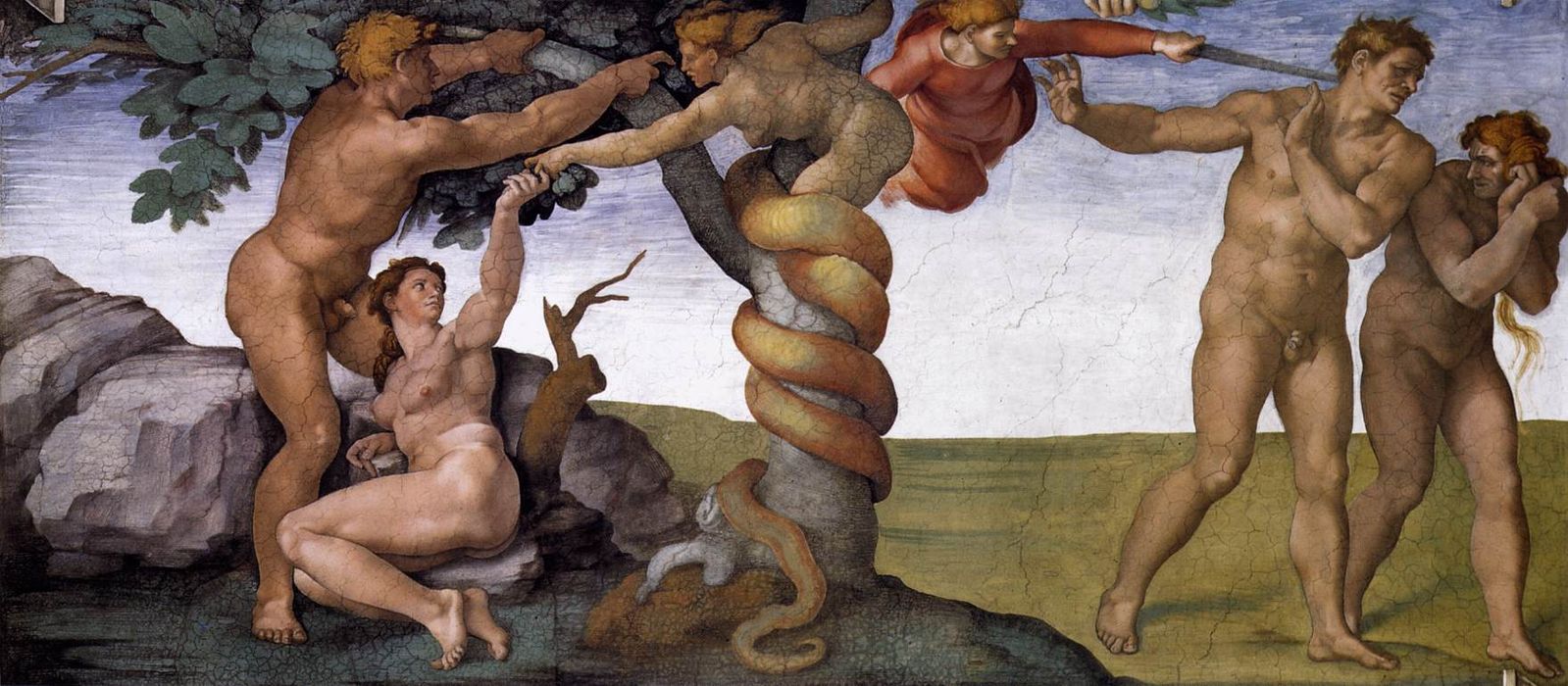
Almost every good story has to have at least one unexpected twist, and the second creation story is no exception. The main one in this story is that after they ate the fruit “The eyes of the two of them were opened” (3:7). Instead of becoming like God and knowing good and evil, instead they “knew that they were naked”. What a disappointment! [1]
The next verse goes on to say “The man and his wife hid themselves from the presence of the LORD God in the midst [בְּתוֹךְ] of the tree (singular) of the garden” (3:8). Similar phrasing is used for the position of the prohibited tree, in the midst of the garden (in 2:9; 3:3). We find them hiding in “the very place of the crime!”[2] As they had made loincloths of fig leaves in the interim, was the prohibited tree a fig tree, or did they return to the scene of the crime?
Perhaps surprisingly, God called out “Where are you?” (3:9). Surprising because God is revealed so early in the Bible to not be omniscient.[3] But instead of answering this innocent question the man answers the unasked question of “Why are you hiding?” and thereby incriminates himself. Not only does he return to the scene of their crime, the man confesses before he’s even interrogated. This is comical.
It seems to have been almost an afterthought that the couple would need to be prevented from eating of the Tree of Life because “he might reach out his hand and take also from the tree of life, and eat, and live forever” (3:22-24). But as there was no prohibition from eating from this tree earlier, couldn’t they already have eaten from it? Did they? The fact that the commentaries produce several different explanations for this anomaly, suggests (to me) that it is intentionally absurd, and that God is portrayed here as thinking “on the go” – he doesn’t have a well-thought-out plan (and the incomplete sentence heightens this sudden sense of urgency – “and now, lest he stretch forth his hand ….” ending abruptly mid-sentence.[4]
Summary and conclusion – the purpose of humour in second account of creation
To sum up: the second account of creation in Genesis 2-3 contains several literary devices which are frequently associated with humour in the Hebrew Bible, especially when they appear in a cluster. These “humour markers” include: puns or wordplays (such as the use of an identical Hebrew word to mean both naked and crafty); absurdities (like a talking animal); contradictions; hyperbole; and unexpected twists.
What could be the possible purpose of this humour?
In the first account of creation (1:1-2:4) the language is structured, lofty, perhaps poetic. God is transcendent. The account concludes with God in his divine council determining to create humanity in their image.
The second account, by contrast, is humorous, it contains absurdities, twists, and God has human characteristics. The first account begins with a spirit or wind (רוּחַ) moving over the water (1:2). In the second account God walks in the garden לְרוּחַ הַיּוֹם “at the breezy time of day” (NJPS) (or, time of the evening breeze NRSV) (3:8). The two accounts are linked – such as here with the use of רוּחַ – but each account has a different perspective. In the first, God presides over creation and creates by fiat; in the second, he walks in it and enjoys the breeze. God is immanent.
The second account concludes with the man and woman becoming “like God, knowing good and evil” (3:5, 22) after first being prohibited from doing so. The first account of creation has man “in the image of God” while the second has man becoming “like God/gods”, linking the two accounts together literarily. [5] As one scholar put it: “If there is a vertical movement in the story, it is not a ‘Fall’, but an ‘Ascension’, toward the rank and species of deity.”[6]
Arthur Quinn, in an essay on biblical humour, asks this question: “There is something inherently funny about monotheism, or rather about human efforts to dramatize it in stories. How can you incorporate an omniscient, omnipotent character into your story without the inadequacy of the representation leading to humorous incongruities?”[7]
Yet it seems to me that this is precisely what the writer or editor of the creation stories deliberately tries to do: in the process of humanity becoming “like God” God is anthropomorphised and thus becomes “like man.” The second account of creation therefore has a movement of humanity towards God and God towards humanity. In contrast to the first account which is highly structured and lofty with a transcendent God, the second account is light-hearted, somewhat comical, and God is immanent. In the first, humanity is at the pinnacle of creation because it is in the image of God; in the second, humanity reaches out for a God-like status, but the result is disappointing because to be “like God” does not mean omniscience. On the contrary, it has unpleasant consequences; it is burdensome and painful; and with it comes the discovery, as the poet Lord Byron put it, that “the Tree of Knowledge is not the Tree of Life.”[8]
[1] “The eyes of the two of them were opened” – just as the serpent had said. “And they knew” – seeing how the serpent had correctly predicted the first part, the response of the reader is primed for similar precision with regard to the second, namely, that they “knew that they were God(like) knowing …” What a letdown to find out that they only “knew that they were nude” (3:7). Reuven Kimelman, “The Seduction of Eve and the Exegetical Politics of Gender,” Biblical Interpretation 4, no. 1 (1996): 9.
[2] Kimelman, “The Seduction of Eve and the Exegetical Politics of Gender,” 10.
[3] God’s lack of omniscience is revealed through the use of interrogatives four times in this story: ‘But the LORD God called to the man, and said to him, “Where are you?”’ (3:9); “Who told you that you were naked? Have you eaten from the tree of which I commanded you not to eat?” (3:11); “What is this that you have done?!” (to the woman 3:13) This last question is exclamatory and displays shock.
[4] There is also a wordplay here, on the verb שָׁלַח “to send”– “now, he might reach out (יִשְׁלַח Qal yiqtol) his hand and take also from the tree of life” (3:22) which recurs in the next verse in a form which means “to send” – “therefore the LORD God sent him forth (וַיְשַׁלְּחֵהוּ Piel wayyiqtol) from the garden” (3:23).
[5] “Most significant of all, and rarely if ever noticed, is the climax of the Garden of Eden story at the end of ch. 3: ‘Behold, man has become like one of us, knowing good and evil’ (3.22). This and the ‘image of God’ passage in ch. 1 are the only two passages in the Pentateuch where God speaks in the first person plural: ‘Let us make man in our image. . . ‘ beside ‘man has become like one of us’. These are also the two main places where the question of resemblance between man and God is discussed. The serpent uses a similar expression earlier in the story: ‘you will become like God (or gods), knowing good and evil’, and the ‘image of God’ language occurs again in chs. 5 and 9. But it surely cannot be a coincidence that the beginning and end of the Genesis account of the creation of Adam focus on this matter of resemblance: ‘in our image’ at the beginning and ‘like one of us’ at the end.” Paul Morris, et al., A Walk in the Garden: Biblical, Iconographical and Literary Images of Eden (London: Bloomsbury, 1992), 65.
[6] Wright, “Holiness, Sex, and Death in the Garden of Eden,” 320.
[7] Quinn, “The Mirth of God,” 41.
[8] Lord Byron, Manfred: A Dramatic Poem, Act I, Scene I, 1817.
 מִקְרָא Mikra: Biblical studies