A reader recently left a comment which began this way: “I would interpret this differently. I would begin with the inerancy [sic] of God’s word …”
I’d like to explore the idea of inerrancy further.
Biblical ‘inerrancy’ is the idea or belief that the Bible is free from any errors. Every word is true. Every word! This idea relies heavily on just one verse in the New Testament:
“All scripture is inspired by God and is useful for teaching, for reproof, for correction, and for training in righteousness, so that everyone who belongs to God may be proficient, equipped for every good work.” (2 Timothy 3:16-17)
The Greek word translated as ‘inspired’ (or ‘given by inspiration’ in some versions) is θεόπνευστος theopneustos and literally means ‘God-breathed’. It occurs in only one place in the entire Bible (the technical term for this is hapax legomena) and rarely in classical Greek literature, so it is difficult to ascertain precisely what it means. In addition, the term “All Scripture” (in the indefinite singular) is also rare. Yet, despite being based on a single word whose meaning is uncertain, a doctrine has developed in many Christian denominations that argues that every word in the Bible is true and ‘inspired’ by God. I touched on this a few years ago and planned to write a series of posts on the subject. I don’t think I ever did that, although I may have touched on it now and again, so it’s time I wrote more on the subject.
But first, I want to come back to my reader’s comment that “I would begin with the inerancy [sic] of God’s word …” Is that the right place to begin a reading or study of the Bible? In biblical scholarship there are two words well-known to students: exegesis and eisegesis.
Exegesis (from the Greek ἐξήγησις, from ἐξηγεῖσθαι, “to lead out”) is a term used in biblical studies to describe the process of drawing out from a text its intended meaning by analysing:
- the historical, political, social and cultural backgrounds of the author and their original audience
- the languages in which the text was written (for the Bible these are primarily Hebrew, Aramaic and Greek although scholars will often look at related languages for help in understanding terms), and features of the grammar and syntax of the text
- the literary genre of the text (a legal text will be written very differently to a love song and if we don’t know the difference it will lead to all sorts of confusion)
Exegesis is a very ancient practice and we have early examples of it in the biblical commentaries amongst the Dead Sea Scrolls (called pesharim) and in the Midrashim, the rabbinical commentaries on the Hebrew Bible.
Eisegesis is the opposite of exegesis. It is the interpretation of a text by reading into it one’s own ideas, biases, or agendas, rather than drawing out the intended meaning from the text itself. It is difficult, perhaps impossible, to completely set aside our own ideas while reading a text. However, if we allow these ideas to determine the meaning before we have begun to analyse the text itself then we are guilty of eisegesis – reading our ideas into the text rather than letting the text speak for itself. This often happens when someone goes to the Bible looking for proof for some idea rather than simply reading the Bible and letting it speak for itself. If we follow good methods of exegesis rather than looking for proof-texts for our own ideas, we will almost certainly change our ideas at some point as we learn and discover what the biblical texts have to say. As our knowledge of the historical and social backgrounds of the biblical writers develops, or we learn more about the languages in which they wrote, we will inevitably abandon old ideas as we gain a deeper understanding of what the biblical writers intended for their audiences.
My reader’s comment that they would begin with the inerrancy of “God’s word” (by which I presume they mean the Bible, although the Bible never describes itself in this way) is a good example of eisegesis. By their own admission the writer has begun with an idea that the Bible is “inerrant”, that is, every word is correct. But we don’t get that idea from the Bible itself. Nowhere does the Bible say about itself that “every word is true” or that it is without errors. In fact, as I’ve demonstrated many times in this blog, the biblical writers often presented more than one account of an historical event which contradicted each other. Their intentions, apparently, were to preserve the various accounts of history and not to tell us which one was right. They had good reasons for preserving differing accounts and accuracy, or “inerrancy,” were apparently not major concerns for them.
In an earlier post I wrote about how 2 Samuel 22 and Psalm 18 begin with almost identical words (“A Psalm of David the servant of the LORD, who addressed the words of this song to the LORD on the day when the LORD delivered him from the hand of all his enemies, and from the hand of Saul.”) However, when we make a careful comparison of the two versions of this psalm we discover that two biblical texts which begin with “David said …” actually differ from each other about once in every four words! In addition, the versions we have of Samuel in the Masoretic Text and the Dead Sea Scrolls, differ in similar ways – about once in every four words. So which text preserves what David ‘originally’ said?
We have to acknowledge that the Bible as we have it includes more than one version of the same events, or the words of individuals such as David. The real problem is for those theologians and modern believers who think that ‘divinely inspired’ means every word of the Bible is true and without error. If two biblical versions of the same event are so markedly different, how can we possibly determine which words are ‘original’ and which are the divinely inspired and inerrant ones?
.jpg)
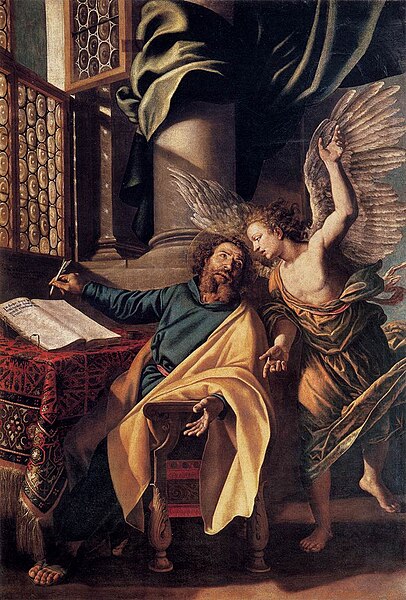
As a final note, I’d like to comment on the painting above by Vincenzo Campi, St. Matthew and the Angel. I’ve used a painting by Caravaggio with the title The Inspiration of Saint Matthew, also showing an angel, in another post (and again here). Caravaggio’s commission of this work for the Contarelli Chapel may in fact have been inspired by Campi’s earlier painting (in the church of San Francesco of Assisi, Pavia). Apart from the obvious feature that both paintings have an angel speaking to the evangelist as he writes his Gospel, Caravaggio makes similar use of light as Campi and beautiful deep, rich colours with quite fine brush strokes.

The angel to the right in both paintings symbolises the Divine and represents the concept of divine inspiration commonly believed in Christian circles. The angel appears to be guiding the pen of the author as to what to write down. This is a powerful and strong image, matching the use of bold, strong colours. A bold statement of Christian faith.
This is not the only artwork to portray such symbolism using St. Matthew. The idea that God is behind the writings of the Bible sends a powerful message of authority to ordinary people. Those in authority knew what they were doing when they commissioned such works. In fact, an earlier work by Caravaggio – St. Matthew and the Angel – was rejected by the church who declared it as an irreverent presentation of St. Matthew because it showed him as too humble and rustic, and because Caravaggio had depicted the saint as a bare-footed and unlearned peasant, gaping in the presence of an angel.
I’ve said that Caravaggio may have been “inspired” by Campi. It was a deliberate play on the “inspiration” of the evangelist and the Bible in general. Does “inspiration” mean that the biblical texts were dictated word-by-word by an angel (as both Campi and Caravaggio portray)? Or were the biblical writers “inspired” by previous writers, popular stories and ideas circulating in their communities, in much the same way as Caravaggio was inspired by Campi?
(Thanks to my go-to Art Historian Stephanie for some comments on the artworks.)
 מִקְרָא Mikra: Biblical studies
