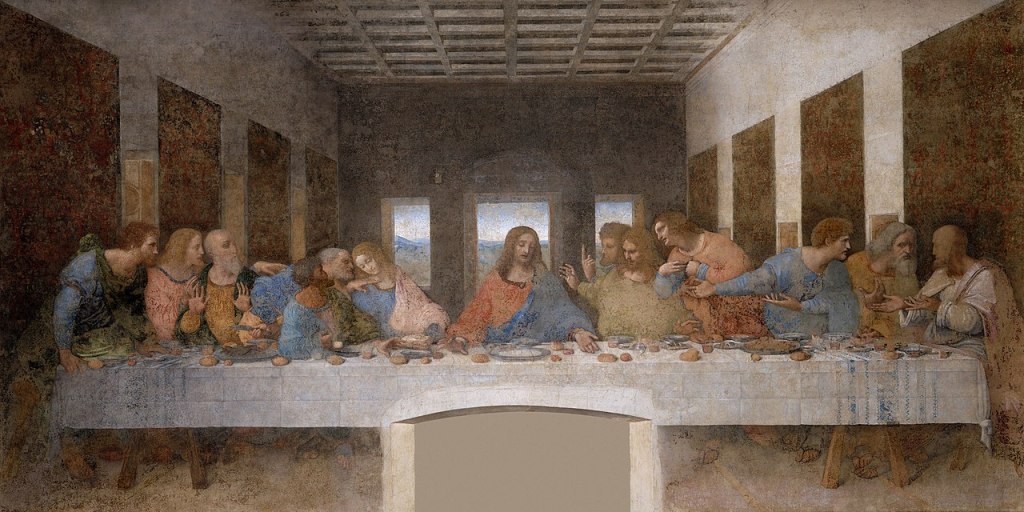
In the Christian calendar today is Wednesday in Holy Week, and tomorrow will be Maundy Thursday which commemorates Jesus eating the Last Supper with his disciples. Many people think this was a traditional Passover meal. This year Easter falls a week after Passover, or Pesach, in the Jewish calendar. In the western church calendar Easter always occurs on the first Sunday after the first full moon after the northern hemisphere spring equinox. Passover always occurs on the 15th day of the Jewish month of Nisan, which is the first month of spring in the Jewish lunisolar calendar. This is a fixed date and will always coincide with the full moon. Because the Jewish calendar is based on the lunar cycles, while Christians use a solar calendar, the calculations for the Jewish Passover and Christian Easter may use a different full moon, and this is why in some years Easter will coincide with the Jewish Passover, while in other years they could be weeks apart.
However, there is some doubt about whether the “last supper” was actually the traditional Passover meal, or if it was an ordinary meal on the day before Passover. The reason for the confusion is that the Synoptic Gospels (Matthew, Mark and Luke) are unanimous that the last supper was the Passover meal, while the Gospel of John seems to suggest that Jesus was crucified at the same time that the Passover lambs were being slain in preparation for the Passover meal, which would be a day later. For many Christians the idea that Jesus died at the same time as the lambs were being slaughtered reinforces the idea that the passover lamb symbolically pointed forward to the death of Jesus, who is “our passover lamb” (1 Corinthians 5:7). I can see why this idea is attractive to many Christians, but is it right?
Let’s look at the biblical evidence in more detail.
- Mark specifies that the last supper was held on the day when the Passover lambs were sacrificed (Mark 14:12). If Mark was right, this verse alone establishes that the lambs couldn’t have been slain the next day when Jesus was crucified.
- Matthew says the last supper was prepared “On the first day of the Feast of Unleavened Bread” (26:17) which confirms Mark’s detail that it was the day the lambs were slain (“On the first day of the Feast of Unleavened Bread, when it was customary to sacrifice the Passover lamb …”). Mark 14:1 also confirms that “the Passover and the Feast of Unleavened Bread” were understood in 1st century Judaism as the same thing. Technically, the festival of Unleavened Bread commenced the day after Passover, but from early times the whole eight days of Passover and then Unleavened Bread were collectively referred to as “Passover” or “Unleavened Bread” or both. Mark’s note that it was the day “when it was customary to sacrifice the Passover lamb” also supports this.
- All the Synoptic Gospels say that in preparing for the last supper “the disciples did as Jesus had directed them and prepared the Passover” (Matthew 26:19 // Mark 14:16 // Luke 22:13).
- During the last supper, according to Luke, Jesus said: “I have eagerly desired to eat this Passover with you before I suffer” (Luke 22:15). He is unlikely to have said “this Passover” if it was an ordinary meal on the day before the Passover.
Then there are several hints elsewhere in the Gospels and in 1 Corinthians that this was the Passover meal. For example:
- Paul refers to the use of unleavened bread in a text which links it with “Christ, our passover lamb” although not in the same section of his letter where he describes the events of the last supper (1 Corinthians 5:7-8). His phrase “let us celebrate the festival” could imply that early Christians continued to celebrate the Passover as an annual festival, distinct from the eucharistic meal which is described in 1 Corinthians 11, although I wouldn’t press the point.
- Paul mentions the ‘cup of blessing’ (1 Corinthians 10:16) when describing the eucharistic elements of bread and wine. This was the name given to the third of four cups of wine which were drank at Passover (the four cups were the cup of sanctification, the cup of wrath, the cup of blessing or redemption, and the cup of acceptance or praise). Luke specifically refers to two of these cups (Luke 22:17, 20).
- In a possible allusion to the Passover meal Jesus used the words “do this in remembrance of me” (1 Corinthians 11:24-25 and Luke 22:19). The purpose of the Passover was that “you may remember the time of your departure from Egypt” (Deuteronomy 16:3). This is not strong evidence but is worth noting.
- When Judas left the room the rest of the Twelve assumed that he going to “buy what was needed for the Feast, or to give something to the poor” (John 13:29). Nineteenth century Jewish-Christian biblical scholar Alfred Edersheim1 tells us that it was permitted to buy some necessary requirement for the meal even during the meal itself. If the meal was the following night (which would follow if Jesus was crucified at the time the lambs were being slain) then this comment about Judas wouldn’t make sense as he’d have all the next day to buy something for the feast and there would be no assumption of urgency. Edersheim also notes that it was a common practice to make a donation to the poor on the evening of Passover.
On the other hand, there is a comment in John 18:28 that appears to contradict this. While describing events which occured on the morning after the last supper John says “Then they took Jesus from Caiaphas to Pilate’s headquarters. It was early in the morning. They themselves did not enter the headquarters, so as to avoid ritual defilement and to be able to eat the Passover.”
Several scholars argue that here is a contradiction between the Synoptists and John, and there were two different traditions within Christianity from earliest times about the day Jesus was crucified. Regular readers of this blog will know that I don’t shy away from contradictions, nor do I feel a need to always harmonise conflicting accounts in order to remove the problem. However, in this instance, I personally think John’s account can easily be reconciled with the Synoptists once we understand the terminology related to the festivals of Israel. John refers to a claim by the Chief Priests that defilement would make it impossible for them to eat the Passover. As I noted above in a comment about Mark 14:1, by the first century CE Passover day and the feast of unleavened bread which followed Passover were referred to collectively as “Passover”. John’s reference could very well be to the priests being unable to join in with the festival meals during the week-long “Passover” festival, and may refer specifically to the morning sacrifice which they ate, and not to the Passover meal itself which had already happened the night before. John may very well be reflecting a tradition which conflicts with Matthew, Mark and Luke, but not necessarily so.
So, in my view, the “last supper” eaten by Jesus was in fact a Passover meal and Jesus was crucified a full day after the Passover lambs were slaughtered.
1 The Life and Times of Jesus the Messiah, 1886.
 מִקְרָא Mikra: Biblical studies
Small correction. Passover is a 7-day (or 8-dayfor those living outside the land of Israel for the past couple of millenia, give or take) festival. Easter this year comes *during* Passover, on the 7th day of the holiday, not a week afterward.
Thanks for that clarification. Strictly speaking, from a biblical perspective, Passover was originally one day (Nisan 14), followed by the Festival of Unleavened Bread (beginning on Nisan 15). The passover lambs were slaughtered and roasted during the afternoon of Nisan 14 and then eaten that evening (and as the Jewish day begins at sunset the passover meal was consumed on Nisan 15). If we include Nisan 14 when the lambs were slaughtered, the combined festivals of Passover + Unleavened Bread lasted 8 days. Since the destruction of the Temple in 70 CE the slaughtering, roasting and eating of lambs has not been possible, so the festival begins on Nisan 15, and for almost two millenia has lasted 7 days (not 8).
I don’t know when it began, but at least 2,000 years ago the terms “Passover” and “Festival of Unleavened Bread” have been used interchangeably to refer to the entire 7/8 days, although biblically there was a distinction between the two.