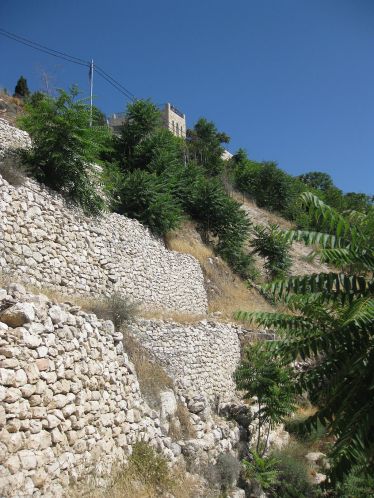
Considering that Jerusalem is such an important city in the Bible and central to Israel’s worship, it is somewhat surprising that so little is said about its conquest in the historical narratives. What little is said also appears to be confusing and contradictory. Let’s try to sort it out.
The earliest biblical reference to the conquest, or rather non-conquest, of Jerusalem is at the beginning of the book of Judges where we read:
Judges 1:19 “The LORD was with Judah, and he took possession of the hill country, but could not drive out the inhabitants of the plain, because they had chariots of iron. 20 Hebron was given to Caleb, as Moses had said; and he drove out from it the three sons of Anak. 21 But the Benjaminites did not drive out the Jebusites who lived in Jerusalem; so the Jebusites have lived in Jerusalem among the Benjaminites to this day.”
This is similar to a statement in Joshua 15:63 that “the Jebusites, the inhabitants of Jerusalem, the people of Judah could not drive out, so the Jebusites dwell with the people of Judah at Jerusalem to this day.” Note that Joshua says that the Jebusites dwelt with the people of Judah (not Benjamin) in Jerusalem “to this day” while Judges says they dwelt with the Benjaminites. A possible reason for mentioning both the tribes of Judah and Benjamin with respect to Jerusalem is that the city lies right on the boundary between the tribes, although neither in the allotment given to Judah (Joshua 15:8), and apparently not in the allotment given to Benjamin either (Joshua 18:16). It seems to be in a kind of “no mans land.”
However, these statements about not conquering Jerusalem are contradicted by an earlier verse in Judges 1 which says “the people of Judah fought against Jerusalem and took it. They put it to the sword and set the city on fire” (v.8). It is difficult to make sense of what is going on in Judges 1. Arguably, the claim in verse 8 that Judah captured the city isn’t necessarily at odds with Joshua 15:63, because the Joshua text descibes the conquest of the land under Joshua, while Judges describes further conquests after Joshua’s death. It is strange, however, that the chapter then goes on to say that Benjamin could not capture the city, and even stranger that both Joshua and Judges note that the Jebusites, the Canaanite occupiers of Jerusalem, continued to live with the Judahites/Benjaminites because they could not be dispossessed of the city. One of the sub-themes in the book of Judges is the denigration of the tribe of Benjamin, in contradistinction to Judah, undoubtedly because the book is laying a foundation for the opposing claims of Saul (of Benjamin) and David (of Judah) to the throne. There may be a hint of this here with the claim that Benjamin could not take the city from the Jebusites while Judah could. The situation, however, is confusing, especially when we come to later accounts of the conquest of the city.
According to 2 Samuel 5:6-9 it was David who conquered Jerusalem from the Jebusites.
2 Samuel 5:6 The king [David] and his men marched to Jerusalem against the Jebusites, the inhabitants of the land, who said to David, “You will not come in here, even the blind and the lame will turn you back”—thinking, “David cannot come in here.” 7 Nevertheless David took the stronghold of Zion, which is now the city of David. 8 David had said on that day, “Whoever would strike down the Jebusites, let him get up the water shaft to attack the lame and the blind, those whom David hates.” Therefore it is said, “The blind and the lame shall not come into the house.” 9 David occupied the stronghold, and named it the city of David. David built the city all around from the Millo inward.
This is in direct contradiction of Judges 1:8 which says the city had been taken previously by Judah. It is unthinkable that such an important city would have been captured and then lost without a mention of it, especially when other texts say the city was not taken by either Judah or Benjamin. Samuel refers to David’s conquest of the city as though it was the first. But what kind of conquest was it? This text in Samuel includes the problematic sayings about “the blind and the lame” and David’s hatred of them. The Hebrew contains some difficult expressions, including the phrase about going up through a “water shaft” and another about attacking the blind and lame. Several explanations have been offered as to what this means. Why did David hate them? Is it because they taunted him? And what is the connection to the “saying” that “the blind and the lame shall not come into the house”? What house?
It looks like the Chronicler had trouble with these expressions as well, so while his account looks like it was sourced from Samuel he left out the phrases which don’t make a great deal of sense:
1 Chronicles 11:4 David and all Israel marched to Jerusalem, that is Jebus, where the Jebusites were, the inhabitants of the land. 5 The inhabitants of Jebus said to David, “You will not come in here.” Nevertheless David took the stronghold of Zion, now the city of David. 6 David had said, “Whoever attacks the Jebusites first shall be chief and commander.” And Joab son of Zeruiah went up first, so he became chief. 7 David resided in the stronghold; therefore it was called the city of David. 8 He built the city all around, from the Millo in complete circuit; and Joab repaired the rest of the city.
The Chronicler removes the difficult phrasing regarding the blind and lame, and the water shaft and instead inserts an account of the attack against Jerusalem being led by Joab, who was rewarded by being made David’s general. I have read several scholarly explanations about what was going on in the Samuel text, and why the Chronicler left out the details about the “water shaft” and “the blind and the lame.” I think the most likely reason he left them out was that by the time Chronicles was written there was already some confusion about their meaning, or that they portrayed David in a negative way (and the Chronicler likes to portray David positively). I personally like Jonathan Grossman’s explanation in an article published just last year [1]. Grossman argues several things convincingly:
- First, he notes that the Samuel text does not read like other conquests recorded in the biblical historical narratives, and suggests that it was a conditional surrender after an attack on the stronghold rather than a full conquest.
- He further argues that the Jebusites regarded the city as a sacred place (for example, it is linked elsewhere in the Bible with Melchizedek “priest of the Most High God” who met Abraham) and therefore anyone with a physical deformity was not allowed to enter it (similar prohibitions on the blind and lame entering sacred places can be found elsewhere in the Bible). As David’s supporters were drawn from the lowest tiers of society (2 Samuel 22:2), his army probably included men with injuries and disabilities and it would have been offensive to the Jebusites if they entered the sacred site.
- Putting these two points together, Grossman speculates that it may have been one of the Jebusites’ terms of surrender that they would hand over the city so long as David respected its sacredness and did not allow the blind and lame to enter it. He translates 2 Samuel 5:6 this way: “And it was said to David, ‘You shall not come here unless you remove the blind and the lame’ [saying, ‘David shall not come here’]”.
- He also argues that the Hebrew word צִּנּוֹר tzinnor/ṣinnôr should not be translated “water-shaft” but rather refers to a weapon used during sieges.
- The awkward phrase translated “Whoever would strike down the Jebusites, let him get up the water shaft” would be better translated as “Whoever attacks a Jebusite—will be struck with the ṣinnôr.” In other words, David accepted their surrender and their terms, and anyone who attacked a Jebusite thereafter would themself be struck down. This explains why the other texts speak of Jebusites living with the occupiers “to this day.”
Grossman’s arguments make good sense to me and I find them convincing. It explains why later these terms of surrender were maintained with prohibitions against people with deformities entering the Temple in Jerusalem: “For this reason, they say: ‘the blind and the lame must not enter the House’ [i.e the Temple]” (v.8).
There is further evidence that this interpretation is right. It explains, for example, why men such as Uriah the Hittite were included amongst David’s highest ranking fighting men, as there is evidence that Hittites/Hurrians held prominent positions in the Jebusite city. I may come back to this some time and discuss Nicholas Wyatt’s interesting ideas about Uriah being the crown prince of the Jebusite city, and his inclusion as part of David’s military elite being one of the outcomes of the surrender.[2]
For the Chronicler, however, David’s military conquest of the city of Jerusalem which was previously unconquerable was a better story than the version in Samuel which was a negotiated surrender. Even in Chronicles though, the victory was not entirely David’s and it is Joab who is credited with taking the stronghold (although, strangely, Joab is left out of the list of David’s chief fighting men later – that’s possibly another story in itself!) This rewriting of history serves two purposes: (1) it avoids difficulties in the text of Samuel by removing them; and (2) it enhances David’s reputation as a conquering hero. For me, however, the Samuel story is the more fascinating one!
__________________________
[1] Grossman, Jonathan. “Did David Actually Conquer Jerusalem? The Blind, the Lame, and the Ṣinnôr.” Vetus Testamentum 69, no. 1 (2019): 46-59.
[2] Wyatt, Nicolas. “‘Araunah the Jebusite’ and the Throne of David.” Studia Theologica 39, no. 1 (1985): 39-53.
 מִקְרָא Mikra: Biblical studies
Jonathan Grossman has a point when he describes this event as a peaceful operation. There is no military conquest here but the employment of a clever ruse. David is in essence not really a man of war, but more a cunning trickster character. He obviously wants to make Jerusalem his new capital, but those pesky Jebusites don’t agree so he has to overcome their resistance, not by force but by cunning.
In my reading of the story I suspect that most of the essentials are just metaphorical idiom. The “lame and the blind” are in fact beggars and the Jebusites compare David to that in order to tell him he is not welcome inside their city. He responds by taking the land surrounding the city to build his home and his own city. There never was a fortress of Sion, that is a later mistranslation. In the Septuagint it says καὶ κατελάβετο Δαυεὶδ τὴν περιοχὴν Σειών, that translates as he took hold of the circumference in order to shake. In Greek σειών can also mean to shake down or extort just like in English and this is what I think is meant here. That the circumference of the old city is alluded to here is confirmed in verse 9 where the building activities are described as being done around from the outside.
The references to a water-shaft in MT or a tiny dagger in the Septuagint are both figurative speech for applying a ruse in my opinion, a tiny dagger as opposed to a full fledged sword, a water-shaft as opposed to the main gate.
On the whole the story also confirms again why the Jebusites are still living among the Israelites. Maybe that was even the original point intended.
Well, well. Leave it to David to finish it appropriately so the story ends full circle. In 2 Samuel 24 we learn how he finally conquered the old city.
18And Gad came to David in that day, and said to him, Go up, and set up to the Lord and altar in the threshing-floor of Orna the Jebusite. 19And David went up according to the word of Gad, as the Lord commanded him. 20And Orna looked out, and saw the king and his servants coming on before him: and Orna went forth, and did obeisance to the king with his face to the earth. 21And Orna said, Why has my lord the king come to his servant? and David said, To buy of thee the threshing-floor, in order to build an altar to the Lord that the plague may be restrained from off the people. 22And Orna said to David, Let my lord the king take and offer to the Lord that which is good in his eyes: behold, here are oxen for a whole-burnt-offering, and the wheels and furniture of the oxen for wood. 23Orna gave all to the king: and Orna said to the king, The Lord thy God bless thee. 24And the king said to Orna, Nay, but I will surely buy it of thee at a fair price, and I will not offer to the Lord my God a whole-burnt-offering for nothing. So David purchased the threshing-floor and the oxen for fifty shekels of silver. 25And David built there an altar to the Lord, and offered up whole-burnt-offerings and peace-offerings: and Solomon made an addition to the altar afterwards, for it was little at first. And the Lord hearkened to the land, and the plague was stayed from Israel.
The Greek version of the story continues the wordplay of encirclement and working inwards to capture the centre. The words for threshing-floor used here are ἅλῳ, ἅλωνι and ἅλωνα, but in fact that could mean any circular plot of land and in the context of the story it could even be the central plaza of the city, which I think it means here. All commentaries of the story I know of assume that this was a straightforward transaction of land for money, but I beg to differ in my assessment. It was a shake-down. David came with a company of servants to Ornan the king(?) of the Jebusites and all language points to him being overwhelmed and scared. Ornan is very reluctant to sell the plot and instead offers to carry the cost of a sacrifice in said place. But David, in a magnificent play of dishonest righteousness forces the sale for a mere pittance, 50 shekels of silver for such a piece of prime real estate plus the oxen for a sacrifice is a blatant mob-style extortion. And in a final wordplay I couldn’t help noticing as of possible application here, ἅλωνα has a second meaning as well, deriving from the verb ἁλίσκομαι it can signify a capture or conquest.