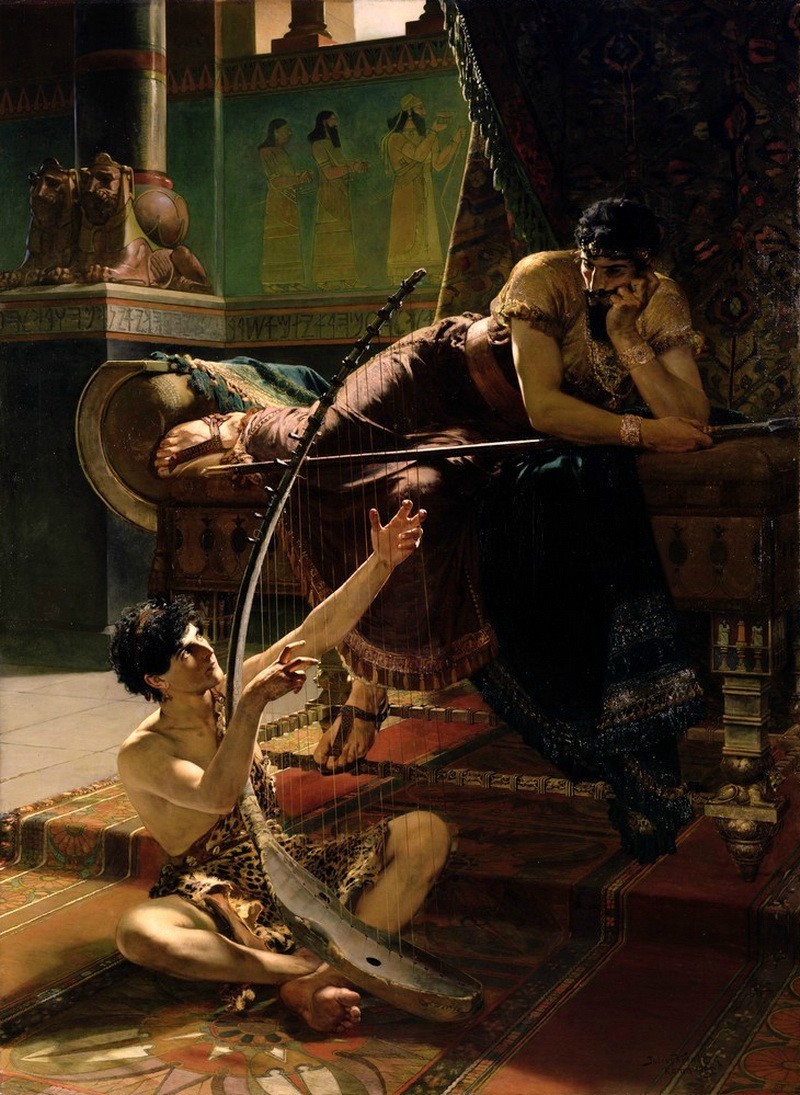
In three previous posts we have used the 1885 painting by Julius Kronberg titled “David and Saul” as an illustration. In my first post in a series titled “The Problem with Saul” (Unmaking a king) I commented in passing about this painting that “one would think from this painting that it was Saul, not Jonathan, who was in love with David!” Interestingly, several other people have also noted the homoerotic overtones in the painting. I used the same painting in an even earlier post about a possible biblical homophobic slur. Stephanie wrote about some of the features of the paintings from an art historian’s perspective (David and Saul, by Julius Kronberg, 1885) and noted that “the motif on the back wall of the palace looks to have a Persian influence.”
In this post I want to comment specifically about one detail on that wall in the backgound which could easily be missed by the casual observer. If you look closely you will see what appears to be a decorative panel running about halfway up the wall, just below the two sphinx-like images. On closer inspection you will see that it is actually some type of script.

In actual fact, this is a text written in paleo-Hebrew, the script in which the Hebrew Bible would originally have been written before the Aramaic or ‘square’ script was adopted (and is still used today in Hebrew Bibles). It’s a continuous line without breaks between words, which makes it a little awkward for reading but was actually the ancient scribal practice. In parts it is difficult to decipher the text because of the lighting, so here is a clearer reproduction.


If you’re interested in what this would look like in an Aramaic or square script, here are the three panels, from right to left (and I’ve inserted spaces where they belong).
So what does it mean? This text is a portion from the Bible (1 Samuel 10:24), from the narrative about Saul’s installation as king by the prophet Samuel. Here is the complete text – the portions in brackets are cut off in the painting so I’ve included them here for context.
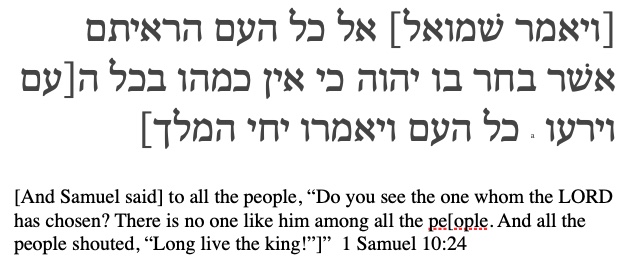
It is interesting that Kronberg has embedded this text in the background of his painting as I suspect most of his initial audience would be unlikely to recognise it, or to even know that it is paleo-Hebrew, the ‘original’ Hebrew of the Bible. I have to wonder whether Kronberg himself was able to read paleo-Hebrew, or, if not, who his scholarly source would have been. At the time this painting was created Kronberg was living in Rome (from 1877 to 1889) and would certainly there have had access to scholars and libraries who could have supplied the text in paleo-Hebrew, but with a keen interest in theology himself I wonder whether Kronberg learned paleo-Hebrew at some time.
See also:
 מִקְרָא Mikra: Biblical studies
“I commented in passing about this painting that “one would think from this painting that it was Saul, not Jonathan, who was in love with David!” Interestingly, several other people have also noted the homoerotic overtones in the painting.”
Hmm, it’s all in the eye and next the mind of the beholder. Let me just add that the peculiar pose of Saul on his couch is suggestive. It’s almost like he is poised to jump the boy with spear in hand. The spear is one of Saul’s most prominent material attributes in his story, in my mind it could be an intended phallic reference and then the interaction between the man and boy becomes definitely homoerotic. The famous tradition about David becoming his armour-bearer could even be construed as a homoerotic double entendre I will try to explain from the Greek version:
καὶ ἠγάπησεν αὐτὸν σφόδρα, καὶ ἐγενήθη αὐτῷ αἴρων τὰ σκεύη αὐτοῦ.
Now Saul at first sight loved him very much or so it says, but what happens next could in translation from Greek be construed as he got aroused or even better an erection. σκεῦος can be translated as the male sex part and I think that is here the case. Interesting to know in old Greek there are very many words that we know are euphemistically used for the same purpose. From the top of my head I could add ὅπλον and of course δόρυ as well, but there are many more. In our own languages we could compose long lists of euphemisms for sexual body parts as well so that’s from all ages.